

Indian farming conditions present unique challenges: thick monsoon grass, woody wild shrubs, and dense weed overgrowth around field borders, irrigation canals, and orchards. While traditional methods rely on manual labor using sickles, rising wages and labor shortages have pushed modern farmers toward mechanization. Finding the best brush cutter for farming in India is now a primary step to improve farm productivity and lower operational expenses.
In this guide, we analyze what makes a brush cutter suitable for Indian agriculture, detail how to choose between backpack and straight-shaft models, and highlight key options that deliver maximum durability in the field.
Key Takeaways
- Substantial Labor Savings: A motorized brush cutter can clear weeds up to ten times faster than manual weeding, significantly reducing labor dependency.
- Selecting Engine Capacity (CC): Match the engine CC to your weed density. Light weeding needs 25–35cc, while thick, woody shrubs require 40cc and above.
- Backpack vs. Straight Shaft: Backpack models distribute weight to the shoulders and are ideal for hilly terrains or orchards, while straight-shaft models offer direct control for flat fields.
- Premium Build Quality: Investing in robust, high-performance engines ensures long-term operational savings and minimal downtime.
Key Criteria for Choosing the Best Brush Cutter for Farming
When searching for the best brush cutter for farming in India, several factors should guide your purchase to ensure you do not end up with an underpowered or unreliable machine:
1. Engine displacement and power output
The power of a petrol brush cutter is determined by its engine displacement, measured in cubic centimeters (CC). If your farm deals with soft garden weeds, a 25cc to 30cc model is sufficient. However, for dense monsoonal weeds and woody brush, you need a high-torque engine. To determine the exact powerhead size required for your land, read our comprehensive analysis on what engine CC is needed in a brush cutter to clear thick Indian weeds. Learn more about the general design of these tools in the Wikipedia Brushcutter Guide.
2. Shaft Configuration (Backpack vs. Bike Handle)
Farmers operating on terraced farms, slopes, or orchards often prefer backpack models. In these units, the engine sits on a padded backpack harness, and power is transferred through a flexible shaft. This layout keeps the hand-held weight minimal, reducing fatigue. Conversely, straight-shaft “bike-handle” models are best for flat, open fields where you can swing the machine in broad arcs.
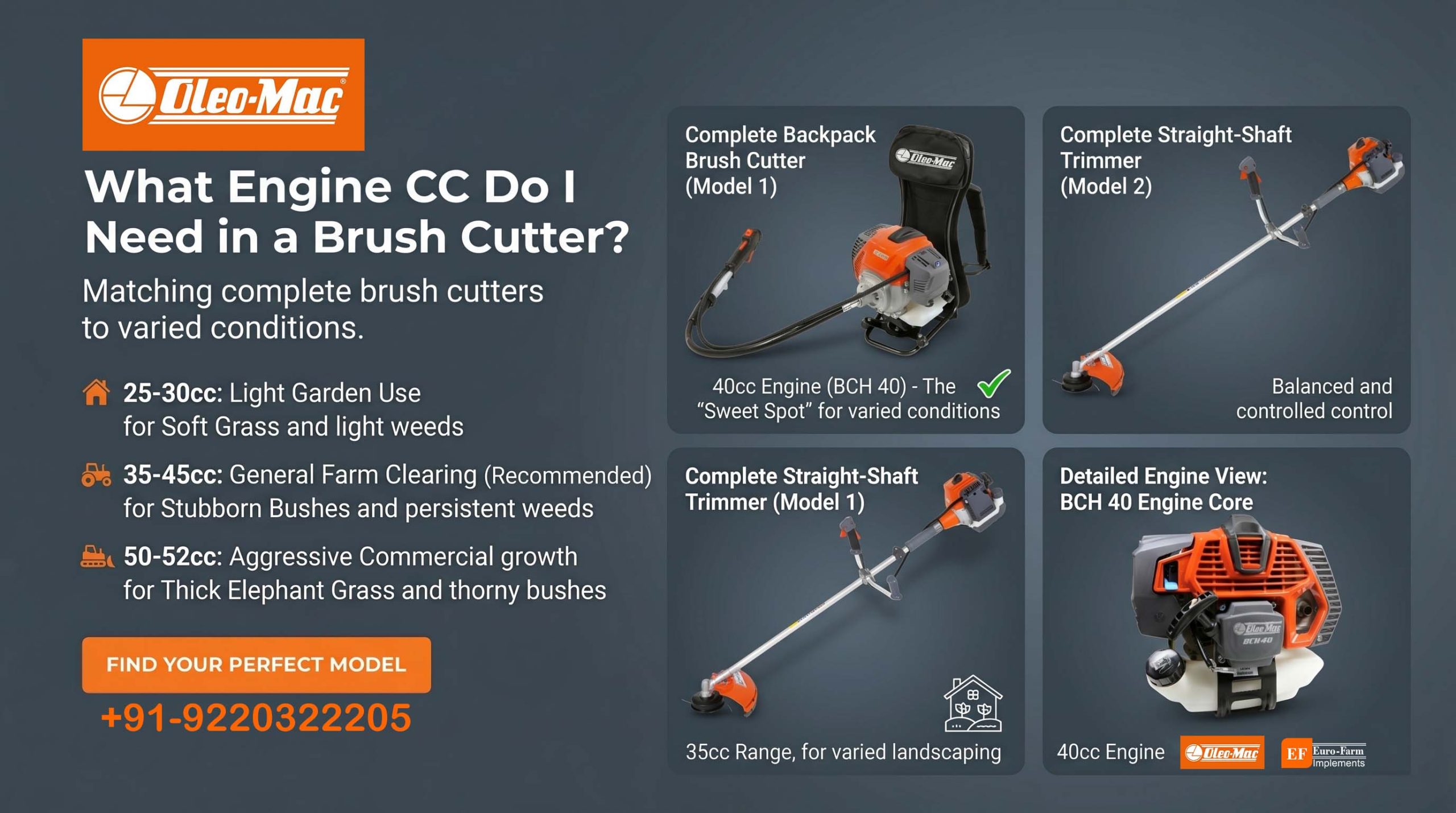
Choosing the correct engine CC helps prevent engine strain and premature wear during field operations.
Subtle High-Performance Recommendations: The Oleo-Mac Edge
For farmers seeking a durable and professional-grade machine, Italian-engineered Oleo-Mac models stand out as some of the most reliable options on the market. They combine high-torque engine power with advanced vibration dampening and self-lubricating bushings, making them excellent candidates for the best brush cutter for farming in India:
- Oleo-Mac BCH 310 T (1.0 HP / 30.0 cc): The Oleo-Mac BCH 310 T is a lightweight, easy-to-handle straight-shaft petrol brush cutter. It is the ideal entry-level option for small-scale farming, lawn trimming, and weed maintenance in orchards and backyard plots.
- Oleo-Mac BCH 40 T (2.0 HP / 40.2 cc): The Oleo-Mac BCH 40 T is a highly versatile bike-handle model. It features a professional-grade steel driveshaft, dual-ring piston, and easy-start system, making it the perfect daily workhorse for medium-sized agricultural holdings.
- Oleo-Mac BCH 746 T (2.5 HP / 45.7 cc): For large-scale clearing, commercial landscaping, and clearing heavy woody brush, the heavy-duty Oleo-Mac BCH 746 T delivers professional-grade torque and cutting speeds under demanding conditions.

Professional bike-handle petrol brush cutters distribute weight evenly and minimize vibration for the operator.
Maintenance Best Practices to Avoid Field Downtime
Even the best brush cutter for farming in India will experience performance drops if neglected. Most starting and running issues are avoidable with simple field habits:
- Ensure Fresh Fuel and Correct Ratios: Always mix fresh gasoline with high-quality 2-stroke oil. Stale fuel attracts moisture and degrades carburetor diaphragms.
- Diagnose Starting Issues Promptly: If your engine fails to fire up on the farm, refer to our troubleshooting walkthrough: Why Won’t My Brush Cutter Start? 5 Fixes You Can Do at the Farm.
- Clean the Air Filter and Spark Plug: Dusty farm environments clog air filters quickly, restricting airflow and causing the engine to run rich. Clean the filter every 10 hours of use.
FAQ Section
What is the best brush cutter engine size for general Indian farming?
For general farming in India, a 40cc (approx. 2.0 HP) petrol engine is the ideal size. It provides the high torque needed to clear tough monsoonal weeds and woody undergrowth while remaining light enough for a single operator to use comfortably.
Can a brush cutter be used to harvest crops like paddy and wheat?
Yes, by fitting a specialized paddy harvesting attachment (a circular multi-tooth blade with a crop collector shield), a petrol brush cutter can be used to harvest crops like paddy, wheat, and fodder grass efficiently.
What is the difference between a backpack and straight-shaft brush cutter?
In a backpack brush cutter, the engine is carried on the operator’s back, transferring power through a flexible shaft. This reduces hand-held weight, making it excellent for slopes and orchards. A straight-shaft brush cutter has the engine mounted directly at the rear of a rigid shaft, providing direct power transfer and better swing control on flat terrains.