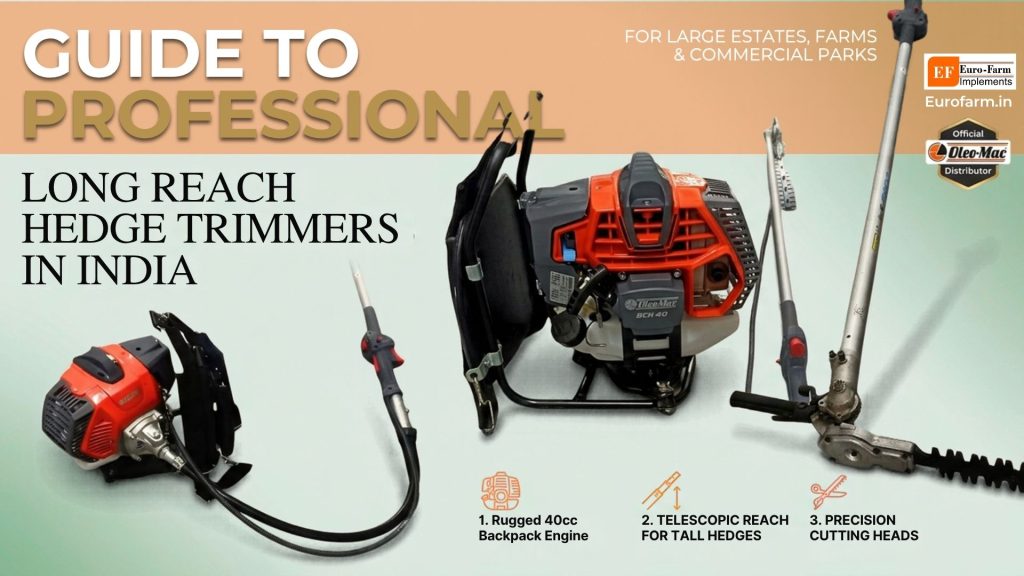
When your crew is trimming tall boundary hedges, estate perimeter walls, or roadside avenue plantings in India’s summer heat, working from a ladder is the weakest link in the process – it slows the work down, introduces fall risk, and tires operators out long before the hedge is finished. A long reach hedge trimmer removes that constraint entirely. This guide explains what to look for when choosing one for professional use in India, using the Oleo-Mac BCH 40 BP as a reference benchmark for the class.

Why Reach Matters More Than You Think on Indian Sites
The boundary hedges found on Indian institutional sites: hotels, resorts, golf estates, cantonment areas, municipal road dividers, and agricultural farmhouses; commonly grow to 2–3 meters in height before a trimming cycle begins. Adding a typical operator height of 1.6–1.7 m and a standard arm extension, a ground-standing operator with a conventional hedge trimmer can only reliably reach about 2.2–2.4 m without a ladder or platform. That leaves the top quarter of any tall hedge untouched or poorly finished.
A purpose-built long reach hedge trimmer extends that working height to approximately 3.5–4 metres from ground level, depending on shaft configuration and how the operator angles the cutting head. The BCH 40 BP achieves up to approximately 10 feet (3 m) of effective reach – enough to dress the crowns of dense Bougainvillea screens, tall Thuja or Cypress hedgerows, and ornamental avenue species without any secondary access equipment.
The practical implication for a grounds maintenance supervisor is significant: one two-person crew (operator plus ground clearer) can complete a stretch of tall hedging that would previously have required a ladder, a spotter, and repeated repositioning. The same job gets done faster and with a smaller team.
The Shaft and Cutting Head – Where the Design Decisions Matter

On a long reach trimmer, the shaft is not merely an extension, it is the primary structural and power-transmission element. Two design factors determine how useful the shaft actually is in the field:
1. Head Angle Adjustability
A fixed-angle cutting head forces the operator to reposition themselves for every different cut angle, vertical face trim, angled face, and flat top crown all require different body positions if the head doesn’t move. The BCH 40 BP’s 135° adjustable cutting head eliminates most of that repositioning. The operator can dial in the flat-top angle from ground level, dress the full crown width, then reset to a vertical position for the side faces, all without moving their feet or re-rigging a ladder. For sites with long linear hedges, this single feature meaningfully compresses cycle time per linear meter.
2. Shaft Length and Drive System
The extended shaft on the BCH 40 BP transmits engine power through a flexible drive cable system designed to handle the torque loads of continuous trimming without whip or vibration buildup at the cutting end. The shaft length is calibrated so that an operator of average Indian build (standing height ~1.65 m) can hold the rear grip at waist height and still reach 10 feet up, which is the ergonomically correct hold position rather than an awkward overhead stretch. Holding the rear grip above shoulder height is one of the fastest ways to generate operator fatigue on a long hedging run; a correctly proportioned shaft prevents this.
The 2.0 HP Engine: Why Output Class Matters for Thick Growth
Indian ornamental hedges are often left to grow significantly between contract trimming cycles, especially on municipal stretches or under-resourced institutional sites. By the time a crew arrives, they may be cutting through 15-25 mm diameter re-growth stems rather than fresh soft growth.
The BCH 40 BP’s 2.0 HP (approximately 1.5 kW) petrol engine keeps the 450 mm double-sided blade running at a consistent cutting speed even under this kind of mid-cycle load. Underpowered machines in this same reach class typically exhibit blade speed drop when hitting dense or woody stems, the blade slows, tears rather than cuts cleanly, and requires multiple passes.
That is the scenario that adds hours to a hedging contract. A correctly sized engine for the blade class prevents blade-bog and delivers a cleaner cut edge on the first pass, which also reduces the risk of fungal ingress through torn stems during monsoon-period maintenance.
Blade Length and Cutting Capacity
The 450 mm blade of the BCH 40 BP covers a generous swath per stroke. For comparison, most domestic or light-commercial hedge trimmers use 400-420 mm blades. The additional 30-50 mm of tooth engagement per stroke is not dramatic in absolute terms, but over a 200-metre run of tall hedging, the cumulative time saving is meaningful.
The blade pitch (tooth spacing) on professional machines like this is also calibrated for cleaner cut edges on stems up to approximately 22–25 mm, the typical maximum re-growth size encountered on annual or biannual trimming contracts.
Weight, Balance, and Operator Fatigue on Long Sessions

This is where the BP (Backpack) configuration of the BCH 40 BP makes a decisive difference for professional, multi-hour use.
On a conventional long-shaft petrol hedge trimmer, the engine sits at the rear of the pole, behind the operator’s hands. As the pole is extended upward and the cutting head angled for flat-top work, the engine weight creates a rearward pivot moment that the operator constantly corrects with downward arm pressure. After 45–60 minutes, this induces fatigue in the shoulder, bicep, and forearm – precisely the muscle groups that need to hold steady for a clean cut line.
The BCH 40 BP moves the engine off the pole entirely. It rides in a backpack harness frame, sitting on the operator’s back and hip girdle – the strongest weight-bearing structure in the body for sustained load. The pole itself becomes dramatically lighter in-hand. The operator’s arms are now controlling direction and cut angle rather than fighting pole-weight. On a 3-4 hour hedging session, this difference is felt acutely: operators using backpack-configuration machines report significantly lower upper-body fatigue, and supervisors see fewer mid-session breaks and more consistent cut quality across the full session.
In India’s summer conditions – 40°C+ ambient temperatures that are typical during pre-monsoon trimming windows in May and June – managing operator fatigue is not a comfort consideration. It is a direct productivity and safety factor. Fatigued operators on long poles near tall hedges are more likely to lose control of the cutting head, produce uneven cut lines, or misjudge their footing. The backpack configuration addresses this structurally rather than relying on the individual operator’s endurance.
Application Sites in India Where This Tool Changes the Workflow
The long reach hedge trimmer with backpack configuration is the appropriate tool – rather than a ladder-based alternative — in the following common Indian site types:
- Resort and hotel perimeter hedges: Tall Thuja, Cypress, or Duranta screens along boundary walls. Guest-facing appearance standards require a clean, level crown line – achievable consistently only with a stable reach tool, not a ladder repositioned every two meters.
- Golf course rough and fairway borders: Mixed species hedgerows at varying heights. Speed of coverage matters; ladder-based crews cannot keep pace with the course maintenance schedule.
- Municipal road dividers and avenue plantings: Often 2.5-3 m tall after monsoon-period growth. Municipal crews need to cover hundreds of linear meters per session, a backpack long-reach tool is the only realistic option at that scale without aerial platforms.
- Cantonment and defence establishment horticulture: High-standard formal hedging around parade grounds and residential zones where appearance standards are non-negotiable and work must proceed without disrupting access.
- Agricultural estates and farmhouses: Windbreak hedges and orchard perimeter screens that need periodic topping. Often no infrastructure for aerial access; the long reach trimmer is the practical alternative.
For brush cutter and vegetation clearing work on the same sites, see our guide on best brush cutters for farming and estate use in India. For grounds maintenance teams requiring blower equipment alongside hedge trimmers, our backpack blower vs handheld blower comparison covers the right pairing for large-site clearance.
Safety: The Actual Case for Going Ladder-Free
Falls from ladders remain one of the most statistically significant causes of serious workplace injury in grounds and horticulture maintenance in India. ESIC and state labour department records consistently list falls from height as a top-three cause of reportable incidents on landscaping and municipal maintenance sites.
When a crew uses a ladder to trim tall hedges, the risk profile includes: unstable footing on uneven ground under the hedge base, ladder tip during reach extension, and falling debris (cut branches) striking the operator or the ladder. None of these risks exist when the operator works with both feet on the ground and an extended-reach tool.
For contractors bidding on institutional or government maintenance tenders, where the client increasingly specifies safe work method statements, being able to document a ladder-free methodology for tall hedge trimming is a concrete differentiator at tender evaluation stage. It reduces the contractor’s own liability exposure and satisfies client safety audit requirements that are now standard on large hotel, resort, and cantonment contracts.
See our detailed guide on procurement of Oleo-Mac equipment for government and municipal tenders for relevant compliance framing.
Oleo-Mac BCH 40 BP Long Reach Hedge Trimmer – Key Specifications at a Glance
| Specification | Detail |
|---|---|
| Engine output | 2.0 HP (approx. 1.5 kW) |
| Blade length | 450 mm double-sided |
| Maximum working reach | Approx. 10 ft (3 m) from ground level |
| Cutting head adjustment | 135° adjustable |
| Power unit configuration | Backpack (BP) – engine on harness, pole in hand |
| Fuel type | Petrol (2-stroke mix) |
| Manufacturer | Oleo-Mac (Emak Group, Italy) – ISO 9001, ISO 14001, CE certified |
For full technical specifications and to request a demonstration or institutional quotation, visit the BCH 40 BP Long Reach Hedge Trimmer product page or contact Euro Farm Implements on WhatsApp at +91 92203 22205.
How to Choose: Long Reach Petrol vs. Conventional Hedge Trimmer
Not every hedging task justifies a long reach tool. Here is a practical decision framework for grounds managers:
- Use a long reach tool when hedge height consistently exceeds 2.0 m, when the site has long linear runs of tall hedging (50 m+), when safety policies restrict ladder use, or when the crew must cover large areas within a tight maintenance window.
- Use a conventional hedge trimmer for hedges under 1.8 m, for topiary and shaped accent plants that need close-proximity precision, or for interior hedge face trimming at waist height.
- Consider the backpack configuration specifically when sessions exceed 2 hours, when ambient temperatures are above 35°C, or when operators are working on slopes or uneven ground where carrying an unbalanced pole is a fatigue and stability risk.
Many professional crews in India carry both: a conventional petrol hedge trimmer for ground-level face work and a long reach backpack model for crown and top work. This two-tool approach produces faster overall cycle times than either tool alone on tall, mature hedgerows.
Frequently Asked Questions
What is the maximum working height of a long reach hedge trimmer?
On a machine like the BCH 40 BP, the effective working reach from ground level is approximately 3 metres (around 10 feet), accounting for operator arm extension. This is sufficient for hedges up to approximately 2.5–2.7 m in height, as the blade approaches from above the crown.
Is a backpack Long Reach hedge trimmer harder to use than a standard one?
Initial familiarisation takes 15–30 minutes for an experienced operator, mainly to learn the harness fit and balance points. Once calibrated, most operators find the backpack unit easier to sustain over long sessions because arm fatigue is dramatically reduced. The pole in-hand is significantly lighter than a pole-mounted engine unit.
Can the BCH 40 BP handle thick, woody hedge stems?
The 2.0 HP engine and 450 mm professional-grade blade are designed for stems up to approximately 22–25 mm in diameter — the typical maximum found in annual or biannual-trimmed ornamental hedges in Indian conditions. For very heavily neglected hedges with stems significantly above this diameter, a pre-clearing run with a pruning saw may be needed before the trimmer is deployed.
Who supplies and services the Oleo-Mac BCH 40 BP Long Reach Hedge Trimmer in India?
Euro Farm Implements India Pvt. Ltd. is the authorized distributor of Oleo-Mac (Emak Group, Italy) equipment for North, East, and West India. Genuine Oleo-Mac spare parts and service support are available through the Euro Farm dealer network. Get in touch with us via Contact us page, or WhatsApp +91 92203 22205.
Further reading: Hedge trimmer – Wikipedia