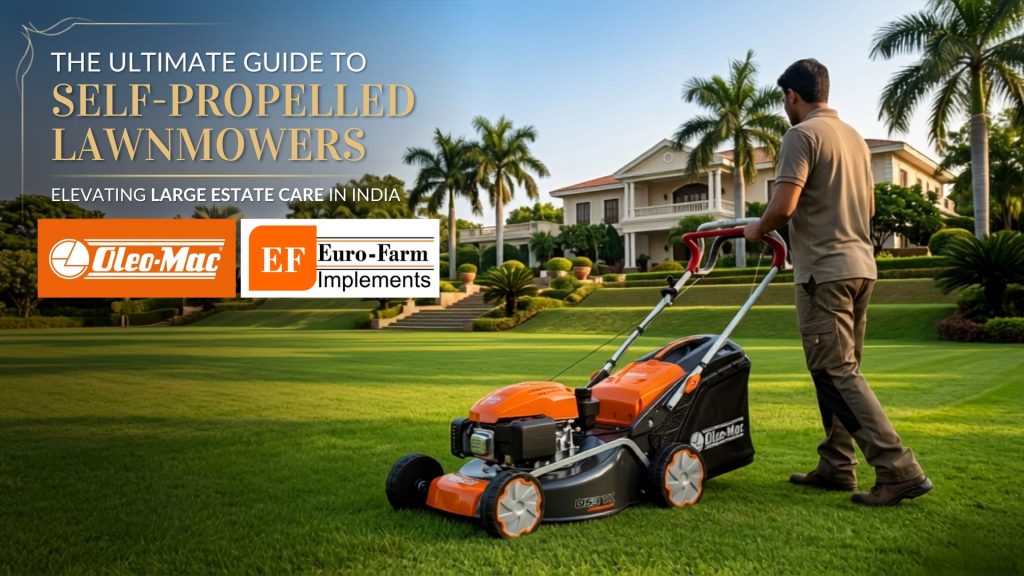
So why Self-Propelled Lawnmowers? Managing a lush, expansive lawn or agricultural estate in India presents unique challenges. From thick monsoon-driven weed growth to sprawling turf grasses like Bermuda and Doob, keeping a neat landscape requires high-performance machinery. A self-propelled lawnmower is the ideal solution for estate owners, commercial landscapers, and agricultural managers looking to reduce physical labor while achieving a clean, professional cut.
In this comprehensive guide, we analyze how self-propelled walk-behind mowers work, compare them to push mowers, and help you choose the right power equipment for your property.
Key Takeaways
- Reduced Physical Strain: Unlike manual push mowers, self-propelled lawnmowers utilize a transmission system to drive the wheels forward, meaning you only need to guide the direction.
- Superior for Sloped and Large Lawns: Ideal for properties ranging from 0.5 to 2 acres, especially those with uneven terrain.
- Optimized for Thick Indian Grasses: Designed to handle dense grasses like Bermuda and Doob grass without bogging down.
- Cost-Efficient ROI: Swapping manual labor for efficient premium machinery cuts down operating expenses (OPEX) and improves lawn health over time.
What is a Self-Propelled Lawnmower and How Does it Work?
A self-propelled lawnmower is an outdoor power tool equipped with a drive system (often a belt-and-pulley transmission connected to the engine) that rotates the wheels to push the mower forward automatically. The operator simply engages a lever (often called a bail bar or drive lever) on the handle and steers the machine.
Depending on the drive configuration, self-propelled mowers are categorized into three types:
- Front-Wheel Drive (FWD): Best for flat lawns. FWD mowers are highly maneuverable because you can easily pivot the mower by pressing down on the handle to lift the front wheels.
- Rear-Wheel Drive (RWD): Offers superior traction. The weight of the grass catcher and the motor sits over the rear axle, making RWD ideal for slopes, hills, and uneven terrains.
- All-Wheel Drive (AWD): Delivers maximum traction across challenging, wet, and rugged terrains.
For a detailed look at lawn care basics, see the Wikipedia Lawn Mower Guide.
Self-Propelled vs. Push Lawnmowers: Which is Right for You?
1. Physical Effort & Terrain
A standard push mower requires the operator’s physical force to propel it forward. While fine for small, flat yards (under 0.25 acres), pushing a heavy steel deck through thick grass on a hot afternoon is exhausting. A self-propelled mower does the heavy lifting, maintaining a steady pace regardless of the terrain.
2. Lawn Size
For larger estates, stepping up to self-propelled machinery is critical for efficiency. However, if your property expands beyond 2 acres, you should calculate how many acres justify buying a garden tractor or ride-on mower to optimize your time and commercial fleet. For large, open commercial lawns, upgrading to a ride-on unit like the Oleo-Mac OM 109 R/19 KV Lawn Tractor is the ultimate way to streamline operations.
Best Practices for Mowing Indian Turfgrasses
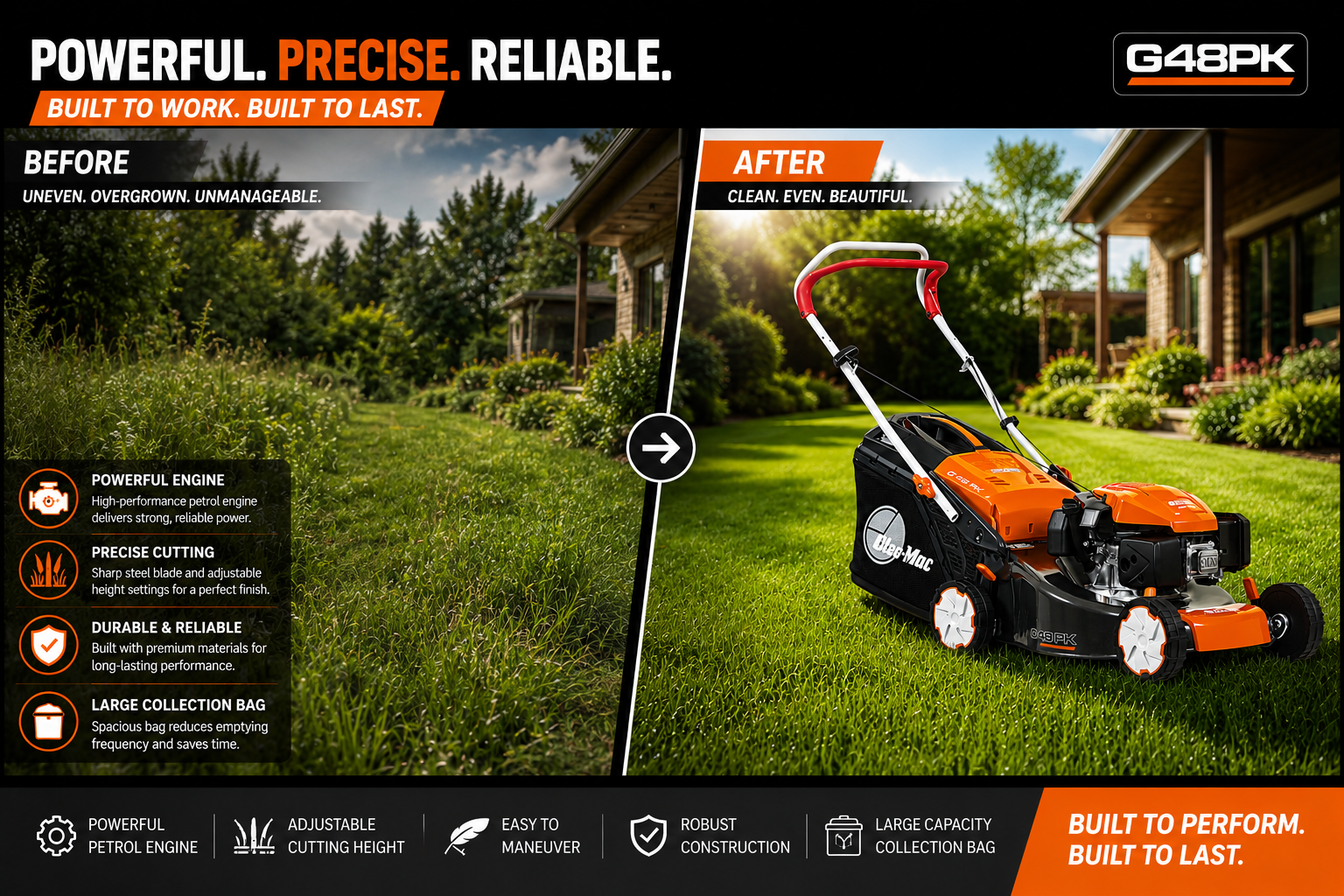
To maintain a healthy, vibrant green lawn in India, selecting the right machine is only half the battle. You must also cut the grass at the proper height.
Different turf species thrive under specific height thresholds:
- Bermuda Grass: Cut to a height of 1 to 1.5 inches.
- Doob Grass: Cut to a height of 1.5 to 2 inches.
Mowing too low, a mistake known as “scalping”, will expose the stems to scorching sunlight, turning your green lawn yellow. For a complete walkthrough on how to set up your mower deck, read our guide on the correct lawnmower height setting for Bermuda and Doob grass.
Additionally, ensuring that your 2-stroke or 4-stroke engines are well-lubricated with high-grade oils like Oleo-Mac Special 2T Oil prevents premature wear and maintains maximum cutting power.
 How Many Acres Justify Buying a Garden Tractor or Ride-On Mower in India?
FAQ Section
What is the main difference between a push mower and a self-propelled mower?
The main difference is the drive mechanism. A push mower requires the operator to physically push the machine forward, relying entirely on human power. A self-propelled mower uses a transmission powered by the engine to drive the wheels forward automatically, requiring the operator only to guide and steer the mower.
Are self-propelled lawnmowers good for slopes?
Yes, self-propelled lawnmowers – specifically Rear-Wheel Drive (RWD) models – are highly recommended for sloped lawns. RWD configurations prevent the wheels from slipping on inclines because the weight of the motor and bagger shifts to the back wheels, maximizing traction.
How often should you service a petrol self-propelled lawnmower?
To ensure long life, perform basic maintenance every 25 to 50 hours of use or once per season. This includes checking engine oil levels, cleaning or replacing the air filter, sharpening the cutting blade, and using fresh fuel mixed with premium oils like Oleo-Mac Special 2T Oil for 2-stroke engines.