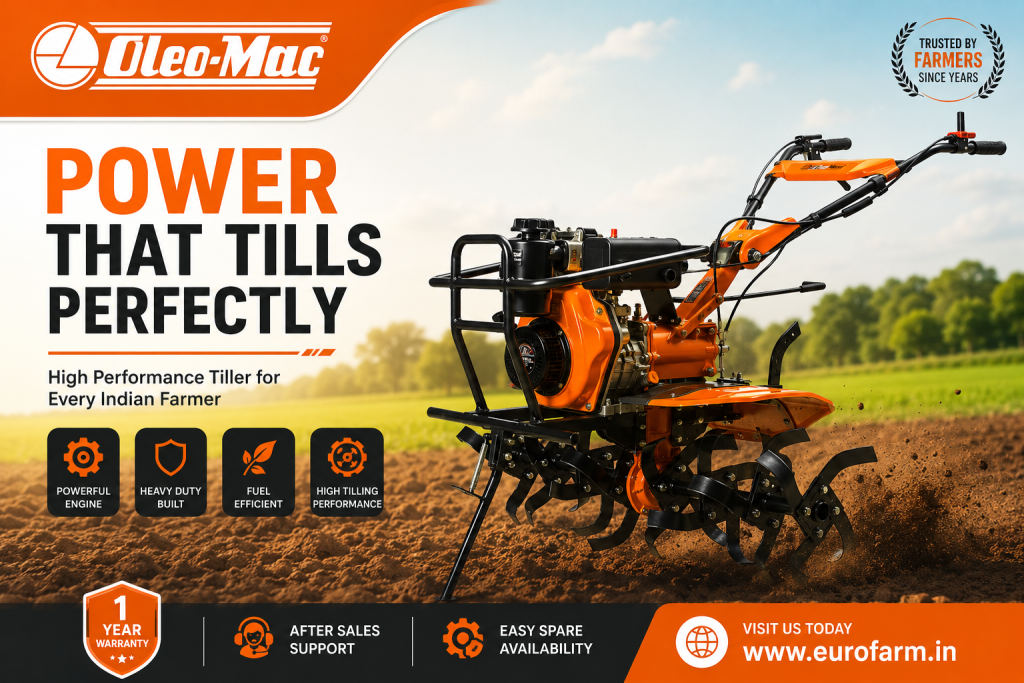
Power weeder Vs rotary tiller which machine is right for your small Indian clay soil farm? Complete comparison with actual prices, performance data, and subsidy details. Read now and make the right decision.
Working with clay soil on small Indian farms is genuinely difficult and buying the wrong machine means wasting both money and effort. Confused between a power weeder and a rotary tiller? This article gives you a real comparison with actual prices, top product options, and a clear recommendation no confusion, no vague advice.
Clay Soil Farming in India: What Is the Real Problem?
Clay soil is heavy, sticky, and compact. After rain, it clings to your feet like cement. In summer, it turns hard as rock. Without the right machine:
- Soil aeration suffers and roots cannot develop properly
- Waterlogging puts your entire crop at risk
- Removing weeds manually becomes nearly impossible
- Labour costs keep rising every season
- Fuel gets wasted running the wrong equipment
One wrong decision in machine selection can ruin an entire farming season.
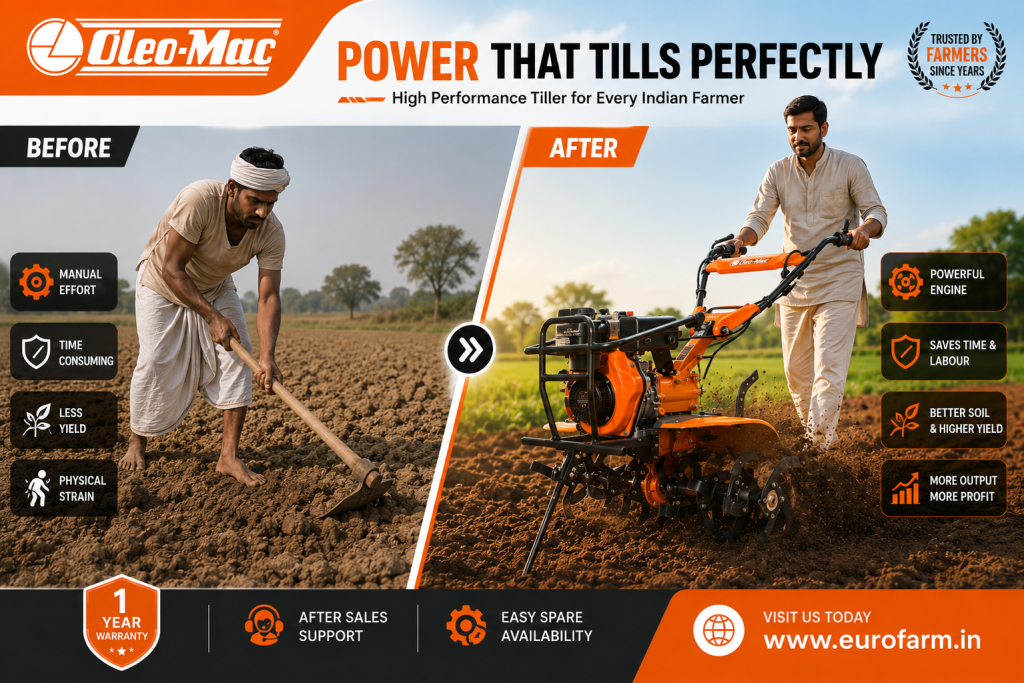
What Is a Power Weeder?
A power weeder is a compact, lightweight agricultural machine designed primarily for weed removal and shallow soil cultivation. It is ideal for vegetable farming, orchards, and small farms.
Main Features of a Power Weeder
- Weight: 50–90 kg (easy to handle)
- Cultivation depth: 5–15 cm (shallow tillage)
- Engine: 5–9 HP petrol or diesel
- Fuel consumption: 0.8–1.2 litres/hour (low)
- Row width: adjustable, suitable for narrow crop rows
A Power Weeder Is the Right Choice If:
- Your farm is smaller than 3 acres
- Your main requirement is weed control
- You grow vegetables or horticulture crops
- The soil is already loose or semi wet (post monsoon)
- You want to reduce daily labour costs
Euro Farm Power Weeders Best Options for Indian Farms
Euro Farm offers Power weeders Vs Rotary Triller specifically tested for Indian soil conditions. Browse the range and choose based on your requirements:
👉 View Euro Farm Power Weeder Collection
Note: For exact pricing and availability, Euro Farm directly or reach out on WhatsApp we will recommend the best model based on your soil type and farm size.
What Is a Rotary Tiller?
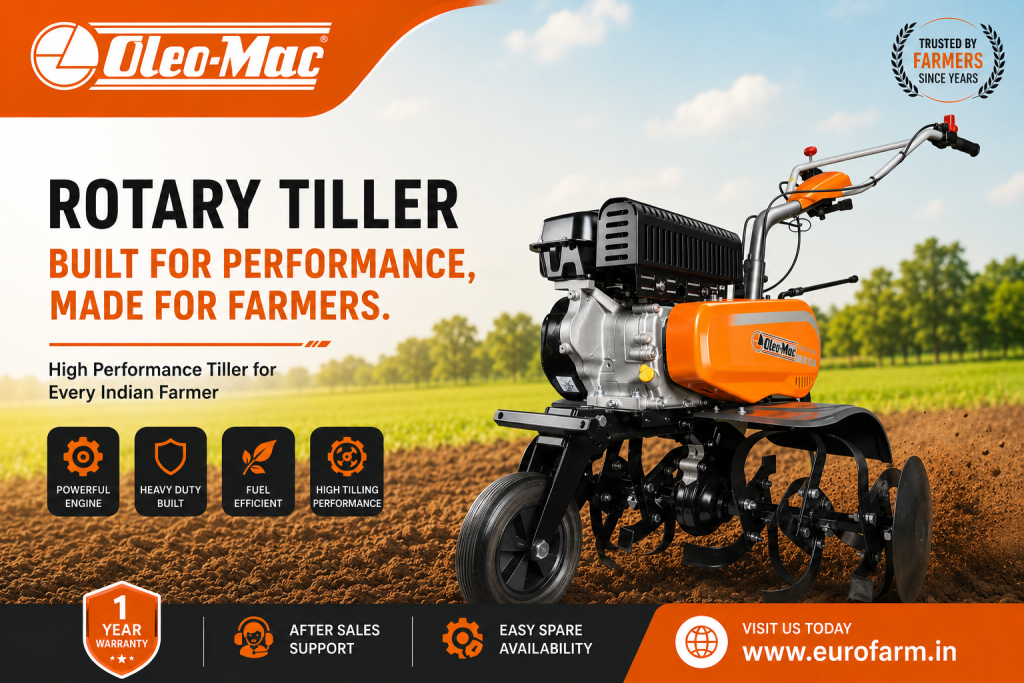
A rotary tiller is a heavy duty soil preparation machine that breaks hard, compact clay soil, mixes crop residue, and prepares seedbeds efficiently. It is primarily tractor mounted, though mini rotary tillers are also available for small farms without a tractor.
Main Features of a Rotary Tiller
- Cultivation depth: 15–25 cm (deep tillage)
- Engine: tractor mounted (35–50 HP) or mini tiller (8–15 HP)
- Fuel consumption: 2–4 litres/hour (higher)
- Blade type: blade or Cblade for hard clay
- Width: 4–6 feet coverage per pass
A Rotary Tiller Is the Right Choice If:
- Your clay soil is very hard and compact (especially in summer)
- You need deep seedbed preparation for wheat, paddy, or sugarcane
- Your farm is in the 3–10 acre range
- You already own a tractor
- You want to mix fertilizer and crop residue thoroughly into the soil
Euro Farm Rotary Tillers Best Options for Hard Clay Soil
Euro Farm’s rotary tillers are designed specifically for heavy duty Indian soil conditions:
👉 View Euro Farm Rotary Tiller Collection
Note: Choosing the right model depends on your soil hardness and whether you own a tractor. Get free guidance from Euro Farm experts we will suggest the right model for your specific situation.
How Does Each Machine Perform in Clay Soil?
Clay soil varies significantly across Indian states. In Madhya Pradesh, Maharashtra, Karnataka, and Andhra Pradesh, the black cotton soil is extremely hard. In Uttar Pradesh and Bihar, clay tends to be somewhat looser.
Loose or semi wet clay soil (post monsoon): A power weeder works perfectly here. The soil is already soft, so shallow cultivation removes weeds effectively and improves aeration without excessive effort.
Hard, compact clay soil (summer or pre monsoon): A power weeder Vs Rotary Triller will struggle blades slip and the machine lacks the torque to penetrate. A rotary tiller is needed to break the soil at 15–25 cm depth.
Practical test: Push your finger 4–5 inches into the soil. If it goes in easily, a Power Weeder vs Rotary Tillerwill work. If it does not, you need a rotary tiller.
💡 Related: If your farm also has thick weeds or dense grass growth, pairing a power weeder with a brush cutter can be very effective. Find out which engine CC is right for your conditions: Brush Cutter Engine CC Guide
Maintenance Tips: Keep Your Machine Running Long Term
Power Weeder Maintenance
- Check blades every 20–25 hours of use clay soil causes faster blade wear than other soil types
- Clean the air filter every week in dusty conditions
- Change engine oil every 50 hours
- Always keep a spare blade set on hand parts are widely available across India
- Clean and store the machine after every use clay sticks to metal and accelerates rusting
Rotary Tiller Maintenance
- Check gearbox oil at the start of every season
- L blades or C blades typically need replacement after 1–2 seasons of use in clay soil
- Check all bolt tightness regularly vibration causes them to loosen over time
- Keep tractor PTO alignment correct misalignment leads to bearing damage and expensive repairs
💡 Related: Learn how to store and protect petrol powered farm equipment during the Indian monsoon season the same principles apply to power weeders and tillers:Petrol Equipment Monsoon Storage & Maintenance Guide
Euro Farm also stocks accessories and spare parts including blades, filters, and maintenance kits so your machine stays in peak condition for longer.
Frequently Asked Questions
Will a power weeder work in clay soil?
Yes, but the soil condition matters. After the monsoon, when the soil is semi wet, a power weeder performs excellently. In summer, when clay becomes as hard as stone, the blades slip and the machine loses traction that is when a rotary tiller becomes necessary. Simple test: if you can break the soil 5 inches deep with your hand, a Power Weeder vs Rotary will manage it.
Petrol or diesel power weeder which is better?
Diesel models cost slightly more upfront but deliver greater fuel savings over time. If you plan to use the machine 4–6 hours per day, go with diesel. For lighter use of 1–2 hours per day, a petrol model is perfectly adequate.
Can one machine handle both tilling and weeding?
Power weeders come with interchangeable attachments tilling blades, weeding blades, and ridgers. Some models also accept a sprayer attachment. However, for deep tilling, a power weeder will never match a rotary tiller’s performance. The two machines serve fundamentally different purposes.
How do I apply for a government subsidy?
Register at You will need your Aadhaar card, land records , and bank account details. After you submit your application, a district agriculture officer verifies it. The subsidy amount is transferred directly to your bank account after the machine purchase is confirmed.
Can a rotary tiller be used without a tractor?
Tractor mounted models require a tractor with a minimum of 35 HP. However, self propelled mini rotary tillers are available that do not need a tractor at all. These are priced in the are a practical option for small farms.
How many acres determines which machine to choose?
Up to 3 acres: A power weeder is clearly better cost effective, easy to operate, and low on maintenance. 3–7 acres: Consider a mini rotary tiller or a quality second hand rotary tiller. Above 7 acres: A full tractor mounted rotary tiller is the right long term investment.
Final Recommendation: Which Machine Should You Buy?
Choose a power weeder if:
- Your farm is 3 acres or smaller
- Your primary need is weed control and intercultivation
- You grow vegetables, horticulture crops, or row crops
- You need to operate the machine single handedly
Choose a rotary tiller if:
- Your clay soil is very hard and compact (common in black cotton soil regions)
- You need deep seedbed preparation for wheat, paddy, or sugarcane
- Your farm is larger than 3 acres or you plan to expand
- You already own a tractor
- You want to eliminate manual labour from soil preparation entirely
If you cannot afford either machine right now: Rent from your nearest Custom Hiring Centre. Rent a power weeder regularly for weed control, and rent a rotary tiller only during seedbed preparation season. Total seasonal cost can be managed .
What Should You Do Now? (Action Steps)
- Test your soil first In summer, try pushing your finger 5 inches into the soil. If it does not go in, you need a rotary tiller. If it does, a power weeder will serve you well.
- Browse Euro Farm’s collection based on your specific need:
- 👉View Power Weeders small farms, weed control, vegetable farming
- 👉View Rotary Tillers hard clay, deep tillage, larger farms
- Get free expert advice Euro Farm’s team will recommend the right machine based on your soil type and farm size, at no cost
- Download the full catalogue Euro Farm’s product catalogue includes all models with complete specifications:
Need help choosing the right machine for your specific farm?Talk directly to Euro Farm share your farm size, soil type, and crop, and get a specific recommendation.
For informartion on latest Farming and Gardening Equipment, subscribe to our Youtube channel
Follow us for facebook