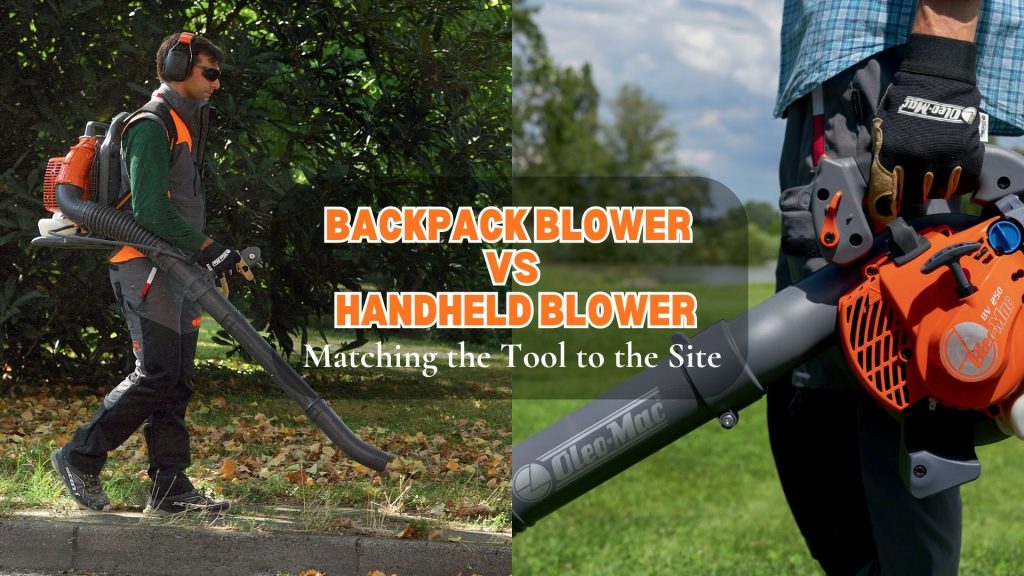
Navigating the choice between a backpack blower vs handheld blower is one of the most practical equipment decisions for estate owners, commercial landscapers, resort groundskeepers, and agricultural operators in India. Managing fallen foliage across expansive properties, clearing heavy monsoon-soaked debris from drainage culverts, or sweeping vast tea and coffee drying yards requires focused air power. However, deploying an undersized blower leads to operator exhaustion, while an oversized commercial backpack blower on a compact paved driveway wastes fuel and restricts maneuverability.
In this comprehensive operational guide, we compare handheld blowers and heavy-duty backpack blowers across crucial performance metrics: air volume (CFM), air velocity, ergonomics, runtime, and total cost of ownership. We analyze the technical capabilities of the Oleo-Mac BV 250 Handheld Blower and the commercial-grade Oleo-Mac BV 901 Backpack Blower to help you match the right machine to your site’s physical scale and operational demands.
Key Takeaways
- Air Volume (CFM) vs. Air Velocity (Speed): Air speed (km/h) dislodges stuck or wet debris, but air volume (Cubic Feet per Minute – CFM) moves large accumulations of leaves across open ground. Backpack units deliver 2x to 3x more CFM than handheld units.
- Ergonomics & Fatigue: Handheld blowers put the full tool weight on the operator’s forearm and wrist (ideal for 15–30 minute quick cleanups), while backpack blowers distribute the engine weight across a padded shoulder harness (built for 3 to 6-hour continuous shifts).
- Site Scale Threshold: Handheld blowers are optimal for properties up to 0.5 acres (villa lawns, resort walkways, patios). Backpack blowers become essential on properties exceeding 1 acre, commercial campuses, and agricultural estates.
- Tackling Wet Monsoon Debris: Heavy tropical monsoon debris and wet mulch require high blowing force (Newton rating) that only large displacement (50cc+) backpack blowers can generate consistently.
Understanding the Core Physics: CFM vs. Air Speed
When comparing blowers, buyers often get misled by air speed numbers alone. To match the tool to your site effectively, you must understand how air velocity and air volume work together:
1. Air Volume (CFM – Cubic Feet per Minute)
CFM measures the total volume of air exiting the blower nozzle every minute. Think of CFM as the width of your broom. A high-CFM blower creates a massive cushion of moving air that sweeps wide swaths of lawn, herding large piles of leaves, dry agricultural husks, or hedge clippings quickly across open turf.
2. Air Velocity (Speed – km/h or m/s)
Air velocity measures how fast the air stream travels as it leaves the nozzle tip. Think of velocity as the stiffness of your broom bristles. High air velocity is necessary to break the surface tension of wet, heavy leaves plastered to concrete, dislodge gravel, or scour debris trapped in grass crowns.
3. The True Indicator: Blowing Force (Newtons)
The true measure of blower performance is calculated as total blowing force, measured in Newtons (N), which represents the combined mathematical product of air speed and air mass volume. Commercial backpack models typically generate 25N to 35N of blowing force, whereas handheld units generate 10N to 15N. Learn more about the general mechanics and engineering of leaf blowers in the Wikipedia Leaf Blower Guide.
Head-to-Head Comparison: Handheld vs. Backpack Blower
| Operational Feature | Handheld Blower (e.g., Oleo-Mac BV 250) | Backpack Blower (e.g., Oleo-Mac BV 901) |
|---|---|---|
| Engine Displacement & Power | 25.4 cm³ / 1.3 HP (1.0 kW) | 77.0 cm³ / 5.0 HP (3.6 kW) |
| Maximum Air Volume | Approx. 720 m³/h (425 CFM) | Approx. 1,620 m³/h (950 CFM) |
| Maximum Air Speed | 70 m/s (252 km/h) | 105 m/s (378 km/h) |
| Tool Weight | 4.1 kg (supported entirely by arm/wrist) | 10.4 kg (carried on ergonomic padded backpack harness) |
| Optimal Property Scale | Up to 0.5 Acres (residential, paved paths) | 1 to 5+ Acres (commercial estates, orchards, campuses) |
| Continuous Shift Duration | 15 to 30 minutes before forearm fatigue | 2 to 6 hours continuous commercial operation |
| Vacuum / Shredder Conversion | Yes (optional vacuum kit converts blower into mulch collector) | No (dedicated high-capacity blow-only unit) |
Deep Dive: When is a Handheld Blower the Smarter Choice?
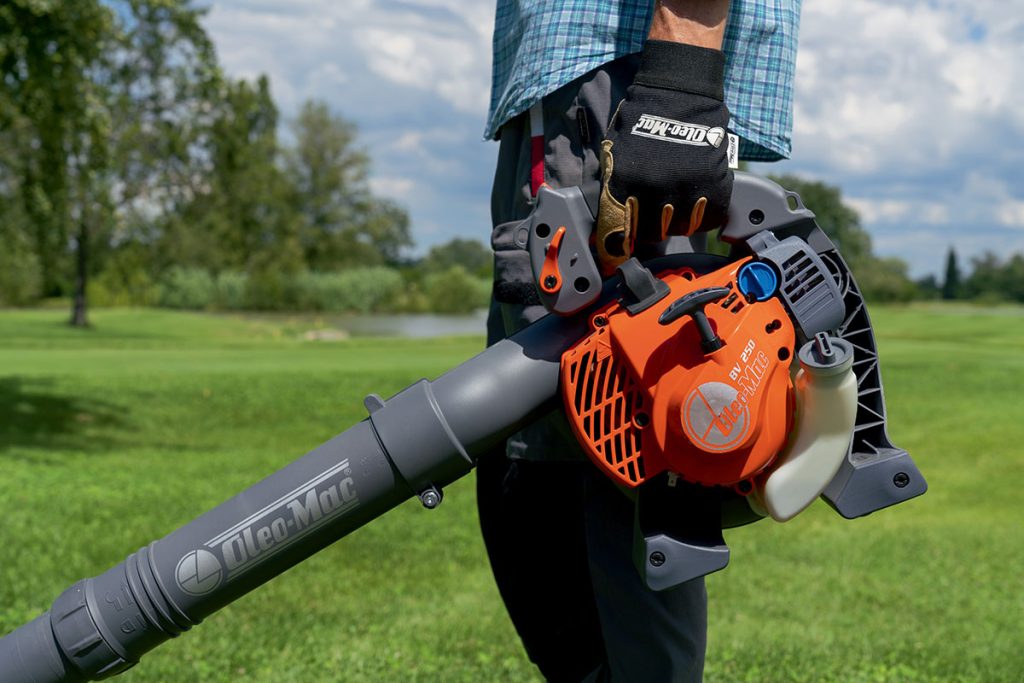
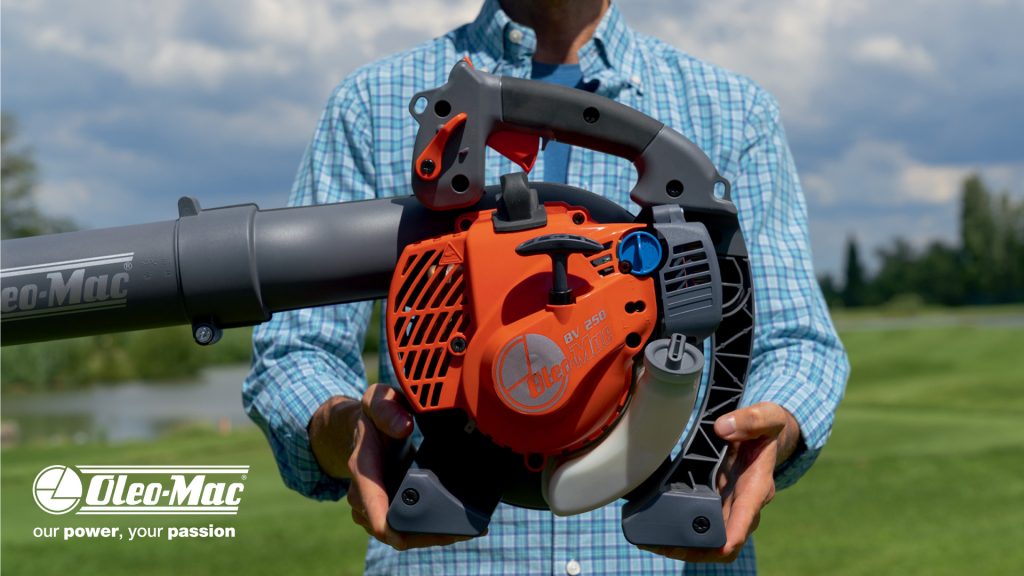
The Oleo-Mac BV 250 Handheld Blower is engineered for agility, precision, and quick turnaround. It is the ideal machine under the following site conditions:
1. Urban Residential Plots & Private Villa Gardens (Under 0.5 Acres)
In compact gardens, maneuvering around flower beds, garden furniture, parked cars, and boundary fences requires pinpoint control. A handheld blower allows you to dial in throttle modulation effortlessly, directing leaves away from delicate shrubs without blowing mulch out of flowerbeds.
2. Hardscape Clearing (Driveways, Patios & Swimming Pool Decks)
Sweeping grass clippings from concrete driveways or pool decks after mowing requires moderate air speed rather than massive CFM volume. The BV 250’s lightweight 4.1 kg profile and multi-blade steel shredder blade (when equipped with the collection vacuum kit) allow operators to bag and shred leaves into organic garden mulch.
3. Elevated & Confined Work (Gutters, Rooftops & Stairways)
If your maintenance routine includes climbing ladders to clear building gutters or cleaning terraced stairways, a backpack blower’s bulk can be hazardous. A handheld blower provides superior one-handed balance and safe, agile portability.
Deep Dive: When is a Commercial Backpack Blower Non-Negotiable?
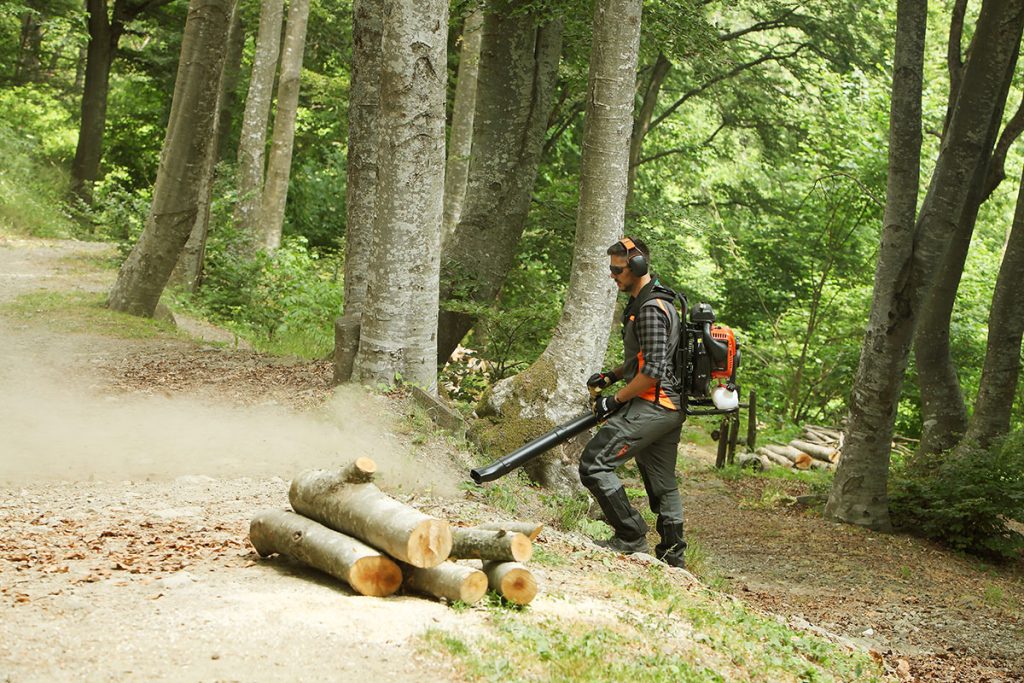
When the scale of the property expands or the density of the debris increases, handheld tools quickly reach their physical limits. The heavy-duty Oleo-Mac BV 901 Backpack Blower (77.0cc / 5.0 HP) is designed for high-intensity commercial grounds:

1. Expansive Institutional Campuses, Resorts & Golf Courses
When maintenance crews must clear several hectares of lawns, parking lots, and road networks, handheld blowers are too slow and cause severe operator muscle fatigue. A backpack blower transfers the machine weight to the operator’s torso and hips via a padded, ergonomic backpack frame, freeing the operator’s arm to effortlessly direct the high-velocity nozzle via an ergonomic joystick throttle.
2. Clearing Monsoon-Soaked Debris and Wet Tropical Foliage
India’s monsoon rains present unique challenges. Wet mango, peepal, and teak leaves plaster to tarmac like papier-mâché. The massive 378 km/h air velocity and 950 CFM volume of the BV 901 break this moisture bond, lifting and tumbling sodden piles of leaves, wet twigs, and mud deposits with ease.
3. Agricultural Processing Yards (Tea, Coffee & Spices)
On coffee and tea estates in Karnataka, Kerala, and Tamil Nadu, high-volume backpack blowers are widely utilized on concrete drying yards to turn parchment coffee beans, disperse chaff, and clear processing areas rapidly, substantially reducing manual sweeping labor.
For large properties balancing multiple maintenance machines, read our executive analysis on scaling estate management equipment and the OPEX advantage of standardizing premium European machinery.
The Dual-Purpose Question: Can a Backpack Mistblower Replace a Leaf Blower?
A frequent question asked by Indian farmers and orchardists is whether an agricultural backpack mistblower (such as the Oleo-Mac MB 80 or BV 163) can double as a daily leaf blower to avoid buying two machines.
While an agricultural mistblower can technically blow air when the chemical tank is empty, dedicated leaf blowers feature distinct nozzle aerodynamics, fan impeller designs, and lighter frame balances tailored specifically for debris clearing. For a thorough technical breakdown of the safety and mechanical trade-offs, read our dedicated investigation: Is It Safe to Use a Backpack Mistblower for Both Leaf Blowing and Orchard Spraying?
Maintenance Best Practices for 2-Stroke Blowers
Because leaf blowers operate continuously at wide-open throttle (WOT) under dusty conditions, strict maintenance discipline is essential to prevent premature engine wear:
- Keep the Air Filter Spotless: Blowers draw in massive volumes of air, sucking in fine dust kicked up from lawns. Inspect and clean the air filter element after every 10 operating hours.
- Use High-Grade Synthetic 2T Oil: Air-cooled 2-stroke blower engines run hot. Always mix fuel with low-ash synthetic ester oil like Oleo-Mac Special 2T Oil (Prosint 2 EVO) at the exact recommended ratio to prevent piston ring sticking and exhaust port carbon choking.
- Fuel Hygiene with E20 Petrol: Avoid storing ethanol-blended petrol in the fuel tank for more than 2–3 weeks to protect internal carburetor diaphragms from moisture degradation.
FAQ Section
Which is better for home use, a backpack blower or a handheld blower?
For most residential homes and private villa gardens (under 0.5 acres), a handheld blower (such as the Oleo-Mac BV 250) is the superior choice. It is lighter (4.1 kg), easier to store, highly agile around flowerbeds, and can be converted into a vacuum shredder for collecting leaf mulch.
When should you upgrade to a backpack blower?
You should upgrade to a backpack blower (such as the Oleo-Mac BV 901) when managing properties larger than 1 acre, when clearing large volumes of wet monsoon leaves, or when operators must work continuous shifts exceeding 45 minutes. Backpack harnesses eliminate arm fatigue by carrying the tool’s weight on the torso.
What is more important for clearing wet leaves: CFM or MPH / km/h?
Both are vital, but air velocity (km/h / MPH) is what initially lifts and breaks the wet leaf’s bond with the ground, while air volume (CFM) is what pushes the heavy mass of wet leaves across the lawn in large piles. Commercial backpack blowers deliver both high speed (300+ km/h) and high volume (800+ CFM) to handle wet conditions.
Can a handheld blower collect and mulch leaves?
Yes, handheld models like the Oleo-Mac BV 250 can be fitted with an optional vacuum collection kit. In vacuum mode, the steel internal impeller shreds dry leaves into fine mulch at a 12:1 reduction ratio, depositing them directly into a shoulder collection bag for garden composting.