

Following a practical chainsaw chain sharpening guide is essential for every farmer, orchardist, estate manager, and forestry operator who relies on power equipment to clear land, harvest timber, or manage tree plantations. In India, chainsaws face demanding conditions: from dense, silica-heavy tropical hardwoods like Sal, Teak, and Babul (Acacia nilotica) to fibrous coconut trunks and abrasive monsoon mud. Under these conditions, a saw chain loses its razor edge far faster than in temperate softwoods. When your chain becomes dull, cutting speed plummets, fuel consumption surges, the guide bar overheats, and physical fatigue dramatically increases the risk of violent kickback.
In this in-depth guide, we provide a definitive, step-by-step masterclass on chainsaw chain sharpening tailored specifically to Indian agricultural and forestry conditions. You will learn the telltale signs of a dull cutter, the exact touch-up intervals needed during field operations, how to select the right file diameter, how to balance the critical relationship between the top plate cutting angle and depth gauge (raker) clearance, and how to choose between precision hand filing and high-speed electric chain grinders.
Key Takeaways
- Sharpen Early, Sharpen Often: Never wait until your chainsaw refuses to cut. Performing a 2-minute touch-up every 1 to 2 fuel refills extends chain life, protects guide bar rails, and prevents engine strain.
- Read the Shavings: If your saw throws fine, powdery sawdust instead of distinct, curly wood chips, your cutters are blunt and require immediate attention.
- Self-Feeding Test: A properly sharpened chainsaw self-feeds into the timber under its own weight; if you have to lean into the handle or force the bar, stop immediately.
- Mind the Rakers (Depth Gauges): Sharpening cutter teeth without lowering depth gauges makes the saw stop cutting entirely; conversely, taking rakers down too low creates severe chatter, binding, and dangerous kickback risks.
- Match the File Diameter: Use the exact round file diameter designed for your chain pitch (e.g., 4.0mm for 3/8″ Low Profile, 4.8mm for .325″, and 5.2mm for 3/8″ standard).
Why Chainsaw Chain Sharpness is Crucial for Indian Farm & Estate Operations
A chainsaw is an indispensable machine on Indian farms, coffee and tea estates, coconut plantations, and agroforestry plots. However, many operators mistakenly treat the chainsaw engine as a brute-force tool, assuming that more engine displacement (CC) will compensate for a blunt chain. In reality, a 40cc chainsaw with a razor-sharp, well-tuned chain will effortlessly outcut a 65cc professional saw running a dull, beaten chain.
Operating a chainsaw with a dull cutting chain causes a cascade of severe mechanical and economic penalties:
1. Excessive Fuel Consumption and Carbon Buildup
When teeth cannot slice timber fibers cleanly, the engine operates under continuous heavy load without reaching its optimal cutting RPM. The centrifugal clutch slips, generating friction heat, while the engine burns significantly more 2-stroke fuel mixture to achieve a fraction of the work. If your fuel contains ethanol, such as India’s E20 fuel blends, sustained high cylinder temperatures exacerbate thermal breakdown of lubricating oils, increasing wear on internal bearings and piston skirts.
2. Severe Guide Bar Wear and Premature Rail Spreading
When cutters are dull, operators instinctively apply downward force onto the handles. This forceful pressure drives the chain drive links violently against the guide bar rails. Over time, the rails flatten, spread outward, and develop sharp burrs. Once the bar rails spread, the chain wobbles side-to-side rather than tracking in a straight groove, causing curved cuts and bar binding.
3. Extreme Operator Fatigue and Increased Kickback Hazard
Chainsaws are engineered to cut timber safely through high chain speed (typically 20 to 25 meters per second) and razor-sharp chisel action. When forcing a dull chain, the operator’s arms, shoulders, and lower back quickly become exhausted. Fatigue is the primary root cause of field accidents. Furthermore, blunt teeth that snag instead of shearing wood fibers drastically increase the likelihood of rotational kickback, the most dangerous event in chainsaw operation.
To understand the mechanics of the saw and the drive system, you can explore the Wikipedia Chainsaw Mechanics Guide.

High-torque petrol chainsaws deliver optimal cutting performance only when cutters maintain a razor-sharp factory profile.
Signs Your Chainsaw Chain is Dull: The 5-Point Field Check
Professional timber fellers and estate groundskeepers do not wait until a chain stops cutting before sharpening. Instead, they monitor continuous performance indicators during every single cut. If your chainsaw displays any of the following five symptoms, pause work and dress your chain immediately:
1. The Sawdust vs. Wood Chip Indicator
Inspect the discharge coming from the side sprocket cover. A sharp chain cleanly severs timber vascular bundles, ejecting coarse, curly, matchstick-like wood chips. A dull chain scrapes and abrades the wood, ejecting fine, flour-like powder. If you see wood powder collecting around the clutch cover, your teeth have lost their working edge.
2. Loss of Self-Feeding Action
When you set a sharp chainsaw onto a log and open the throttle, the cutters pull the guide bar down into the cut smoothly without requiring downward pressure. If you have to lean your body weight onto the front handlebar or yank the rear handle upward to make progress, your cutters are severely blunted.
3. Curved Cutting and Wandering in the Kerf
If your cut starts straight but slowly veers to the left or right, or binds halfway through a log, your cutters are unevenly sharpened. This happens when teeth on one side of the chain have hit dirt or rocks, or when a right-handed operator files the left-hand teeth more aggressively than the right-hand teeth.
4. Smoke and Heat Despite Proper Bar Lubrication
Friction generates heat. Even if your automatic chain oiler is functioning perfectly and dispensing oil, a dull chain will overheat the bar and chain rapidly, producing a scorched wood odor and fine wisps of white smoke at the kerf.
5. Excessive Vibration and Bouncing (“Chatter”)
A chain with incorrect depth gauge clearance or irregular cutter angles bounces violently across the timber surface rather than engaging smoothly. This chatter causes hand numbness, rapid operator fatigue, and excessive stress on the saw’s anti-vibration rubber mounts.
How Often Should You Sharpen a Chainsaw Chain in India?
A common question asked by estate workers is: “How many hours can I cut before sharpening?” In tropical and subtropical Indian agriculture, measuring sharpening intervals purely by operating hours is a recipe for ruined equipment. Instead, frequency depends entirely on timber species, wood cleanliness, and operating environment.
The Golden Rule: The Fuel-Tank Touch-Up
Under standard clean farm cutting conditions (e.g., pruning mango orchards, felling subabul, or processing dry firewood), you should lightly touch up your cutters every time you refill the fuel tank (approximately every 45 to 60 minutes of intermittent cutting). Giving each cutter two or three light strokes with a round file takes less than 3 minutes, restores the razor edge, and preserves the life of the tooth far longer than letting the chain become completely blunt.
Challenging Indian Cutting Conditions That Require Immediate Sharpening
- Ground Contact (Dirt & Stones): If your spinning chain touches sandy soil or a buried rock for even half a second, the chain is instantly dulled. Dirt contains quartz silica, which has a higher hardness than tempered chrome cutter steel. You must stop immediately and restore the working corners.
- Mud-Caked Monsoon Timber: During the Indian monsoon season, logs dragged across red laterite or black cotton soil become embedded with abrasive mud. This mud acts like grinding paste against high-speed teeth. Wash or debark timber along the cut line whenever possible.
- Silica-Rich Hardwoods (Babul, Sal, Tamarind): Native Indian hardwoods have extremely dense grain packed with natural mineral crystals. Expect to double your touch-up frequency when bucking seasoned acacia or tamarind logs.
- Coconut and Areca Palm Stems: Palm trunks are not true timber; they are dense bundles of fibrous vascular tissue surrounded by tough, moisture-laden fibers. These stringy fibers wrap around dull cutters and generate intense friction heat.
For seasonal maintenance and storage protocols between monsoons, read our detailed guide on how to store and maintain a petrol chainsaw during the Indian monsoon season.
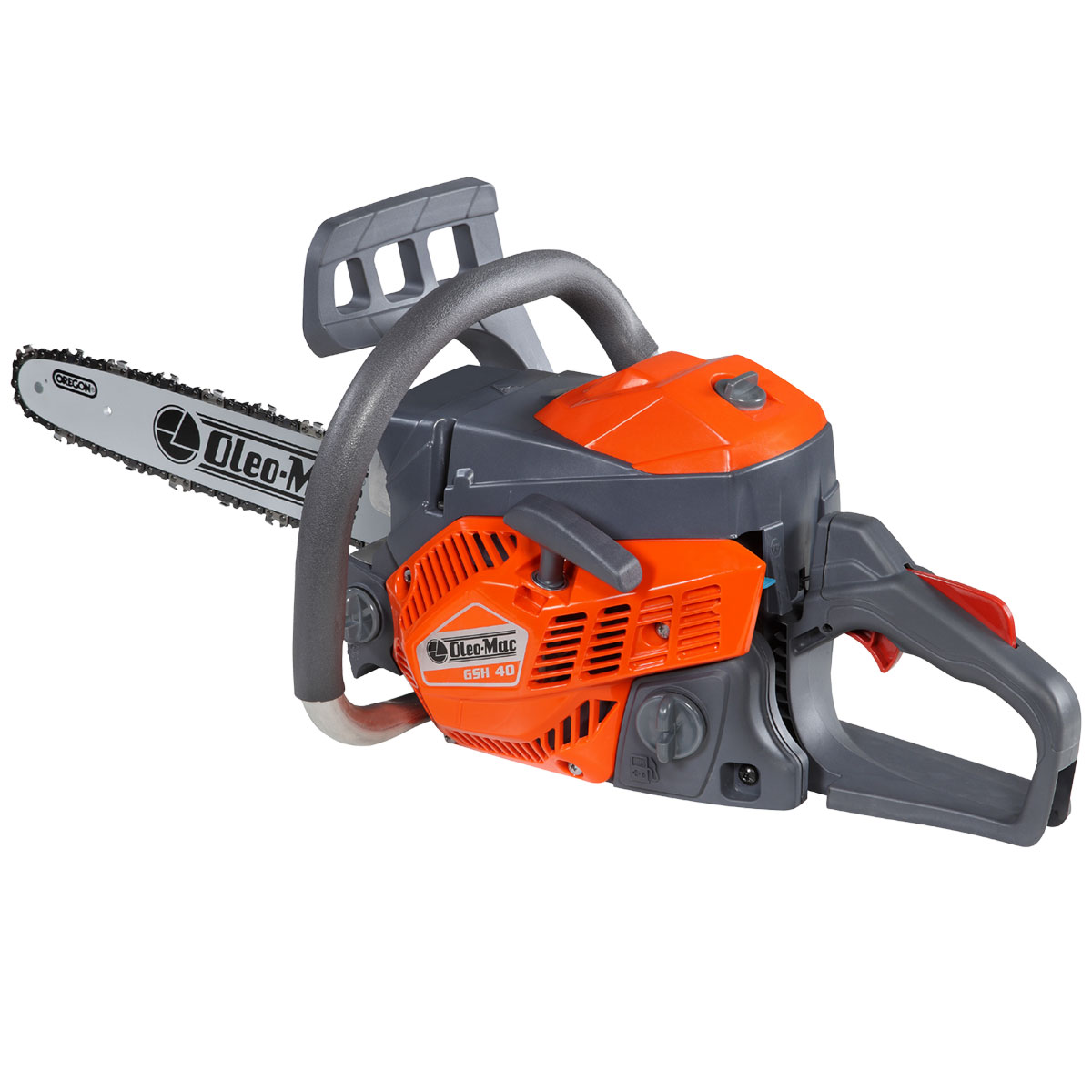
Versatile petrol chainsaws like the Oleo-Mac GSH 40 maintain exceptional fuel efficiency and longevity when paired with sharp chains.
Anatomy of a Chainsaw Chain Cutter: Understanding Angles & Clearances
To sharpen a chainsaw chain properly, you must understand the geometry of each cutter link. A modern saw chain cutter functions like a miniature wood chisel or hand plane. It consists of four critical structural components:
1. The Top Plate
The flat upper surface of the cutter that slices the timber fiber. The edge across the front of this plate is the top plate cutting edge. It is typically sharpened at an angle of 30° to 35° relative to the guide bar.
2. The Side Plate & Working Corner
The vertical wall on the outer side of the tooth. The intersection where the top plate meets the side plate is called the working corner. This microscopic point does roughly 80% of the initial wood severing work. If the working corner is chipped or rounded off by a stone, the entire tooth ceases to cut.
3. The Gullet
The hollow curved space beneath the top plate. The round file sits inside this hollow to carve out the curved cutting profile and clear chip passages.
4. The Depth Gauge (Raker)
The rounded metal fin situated directly in front of each cutting tooth. The depth gauge does not cut wood; instead, it determines how deep the cutting edge bites into the wood. The clearance between the top of the depth gauge and the top of the cutting edge is typically set to 0.025 inches (0.65 mm) for general farm work. If the raker is too high, the cutter cannot touch the wood. If it is filed too low, the tooth takes too large a bite, causing violent bucking, stall, and chain breakage.
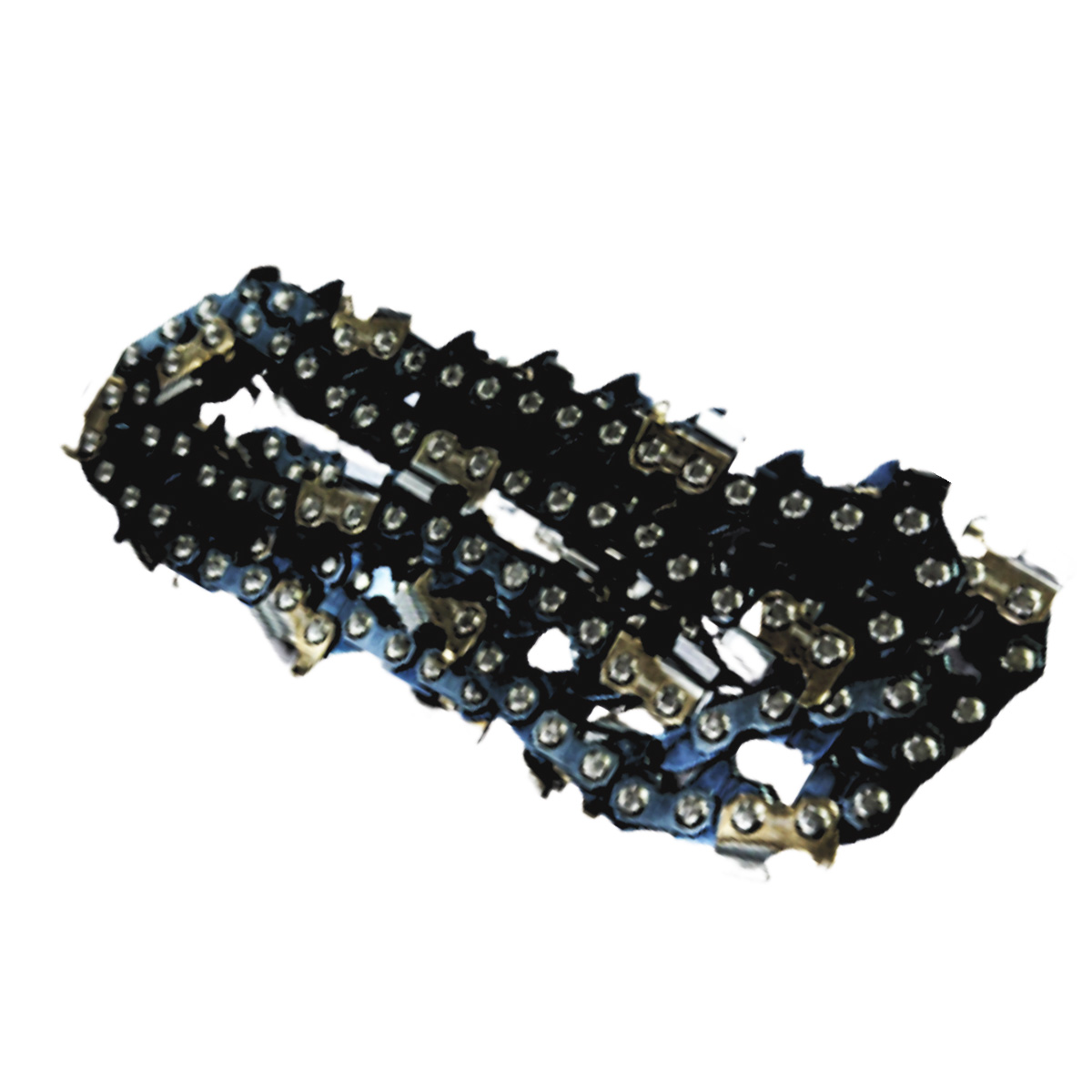
Professional replacement chains like the Oleo-Mac Saw Chain feature precision factory-ground top plates and hardened chrome cutters.
Essential Chainsaw Sharpening Tools & Sizing Charts
Sharpening a chainsaw chain accurately requires the correct diameter tool for your chain pitch. You cannot use a generic workshop file. Using an incorrectly sized file creates a defective hook angle or incorrect back slope, ruining cutting efficiency.
Round File Diameter Sizing by Chain Pitch
| Chain Pitch | Typical Application in India | Required Round File Diameter | Imperial Equivalent |
|---|---|---|---|
| 1/4″ & 3/8″ Low Profile (Picco) | Pole pruners, light arboricultural saws (e.g. GSTH 240) | 4.0 mm | 5/32 in |
| .325″ Pitch | Medium farm & estate saws (e.g. GSH 40, GSH 51) | 4.8 mm | 3/16 in |
| 3/8″ Standard Pitch | Heavy professional logging saws (e.g. GSH 56, GS 650) | 5.2 mm | 13/64 in |
| .404″ Pitch | Heavy industrial mechanical harvesting & timber mills | 5.5 mm | 7/32 in |
For farm owners looking for an all-in-one professional maintenance solution, the Oleo-Mac File Set (4.0mm, 4.8mm, 5.2mm) provides the exact hardened files and wooden handles needed to service everything from small orchard pole pruners to commercial logging chainsaws.
Chainsaw Demos
Step-by-Step Guide: How to Sharpen Your Chainsaw Chain Right by Hand
Hand filing with a round file and guide remains the gold standard for maintaining chainsaw chains. Hand filing removes very little steel per sharpening, preserving chain life while producing a sharper, more durable edge than high-speed power tools that can overheat cutter temper. Follow this 6-step procedure:
Step 1: Secure the Chainsaw and Tension the Chain
Never attempt to file a loose chain. Mount the chainsaw securely in a bench vise by the guide bar, or clamp the guide bar into a stump vise if you are in the field. Slightly increase chain tension so that the cutter teeth do not rock back and forth on the bar rails under file pressure. (Remember to reset normal operating tension before starting the engine).
Step 2: Clean the Chain and Locate the Master Cutter
Wipe all resin, sap, and grit off the chain cutters using a wire brush and a solvent. Inspect the entire chain loop to find the most damaged or shortest cutter tooth. This tooth is your master cutter. Sharpen this tooth first, count the exact number of file strokes required to clean up its working corner, and apply that same number of strokes to every other cutter on the chain. Keeping all teeth equal in length ensures straight, smooth cuts.
Step 3: Position the File and Guide Frame
Place your round file into the gullet of the master cutter. Ensure your file meets these three strict geometric alignments:
- Top Plate Angle: Align the file guide mark parallel to the guide bar (normally 30°, or 25° for ultra-hard timber).
- Horizontal Orientation: Keep the file level at 90° to the vertical plane of the guide bar (unless your chain specifies a 10° tilt angle).
- Height (File Diameter Exposing): Exactly one-fifth (20%) of the round file’s diameter should protrude above the top plate cutting edge. If the file sits too deep, you create an excessive “hook” angle; if it sits too high, you create a blunt “back slope”.
Step 4: Execute Smooth, Forward-Only Filing Strokes
Push the file forward smoothly from the inside of the cutter toward the outside corner using firm, two-handed pressure. Rotate the file slightly with your fingers during the forward stroke to ensure even wear across the file teeth. **Lift the file completely off the tooth on the return stroke. Dragging a file backward dulls the file teeth and leaves jagged burrs on the cutter steel.
Step 5: File All Cutters on One Side, Then Switch
File every alternate tooth pointing in the same direction along the loop. Once complete, rotate the chainsaw around (or step to the opposite side of the bench) and file the opposite-facing teeth using the identical number of forward strokes.
Step 6: Check and Adjust Depth Gauges (Rakers)
After filing your cutters three or four times, the top plate height drops relative to the depth gauge. Place a depth gauge tool (progressive or flat slotted gauge) over the cutters. If the depth gauge fin protrudes above the slot, file it flush using a specialized flat file. Once filed, lightly round the front leading corner of the raker fin to ensure smooth timber entry.
If you ever need to shorten a stretched chain loop or replace damaged links, an industrial tool like the Oleo-Mac Chain Breaker allows you to punch rivets cleanly without damaging adjacent drive links.

High-strength chain breakers simplify repairing snapped cutters or resizing loops for different bar lengths.
Hand Filing vs. Electric Grinders: Which is Best for Indian Farms?
Farming enterprises and commercial logging contractors often debate whether to stick with traditional hand files or invest in specialized benchtop or battery-powered electric chain grinders.
The Case for Hand Files (Field Maintenance)
- Portability: A file kit fits into your pocket or chainsaw scabbard, allowing instant touch-ups deep inside coffee estates or forest compartments.
- Maximum Chain Lifespan: Hand filing removes only microscopic layers of worn metal (typically 0.05 mm to 0.1 mm per touch-up). A single chain loop can be hand-sharpened 20 to 30 times before reaching its wear marker.
- Preserves Steel Temper: Filing creates no frictional heat, preserving the metallurgical hardness of the cutter’s chrome plating.
The Case for Electric Chain Grinders (Workshop Overhauls)
When a chain strikes a hidden iron spike, stone, or barbed wire fence, hand filing out the deep gouges across 60 to 72 cutters can take over an hour. This is where an electric grinder becomes essential. Modern battery-powered units like the Oleo-Mac Micro Jolly Battery Chain Grinder Machine offer workshop-precision angles with 12V field convenience.
Electric grinders use calibrated clamping vices to restore uniform angles and tooth lengths in minutes. However, operators must use light tapping touches to prevent blueing (overheating) the steel, which softens the tooth edge. Always ensure your grinder is fitted with a true, balanced wheel such as the Oleo-Mac Grinding Wheel to avoid burning cutters.

The Oleo-Mac Micro Jolly battery grinder delivers shop-level angle precision for heavily damaged chains.
Indian Wood Species Breakdown: Recommended Filing Angles
India boasts diverse agroclimatic zones with unique timber species ranging from soft poplars to silica-dense hardwoods. Adjusting your top plate filing angle according to the wood species you are harvesting delivers optimal cutting speed and edge retention:
1. Dense Hardwoods (Sal, Teak, Babul, Sheesham)
- Recommended Top Plate Angle: 25°
- Depth Gauge Clearance: 0.020 in (0.50 mm)
- Rationale: A blunter 25° angle leaves more structural steel behind the cutting edge, preventing the working corner from chipping when penetrating dense growth rings. Lowering the raker clearance slightly reduces aggressive biting into dense grain.
2. Plantation Softwoods & Resinous Trees (Pine, Poplar, Silver Oak)
- Recommended Top Plate Angle: 30° to 35°
- Depth Gauge Clearance: 0.025 in to 0.030 in (0.65 mm to 0.75 mm)
- Rationale: Softer fibers cut easily with a sharper, more aggressive shearing angle. Deeper raker clearances allow the cutters to pull larger wood chips without bogging down the engine.
3. Stringy Plantation Canopies (Coconut, Areca, Bamboo)
- Recommended Top Plate Angle: 30°
- Depth Gauge Clearance: 0.025 in (0.65 mm)
- Rationale: Palm fronds and bamboo culms contain silica fibers that instantly dull blunt teeth. Maintain a strict 30° angle and inspect your chain cutters frequently. For harvesting tall palms, check our review of the Petrol Pole Pruner Machine for Tree Cutting.
For matching guide bars to your specific saw displacement and timber size, consult our dedicated Chainsaw Bar Length Guide for Farm Use in India.
Common Chainsaw Sharpening Mistakes and How to Avoid Them
Even seasoned farm mechanics occasionally make subtle filing errors that degrade chainsaw performance. Avoid these five common pitfalls:
1. The “Hook” Defect (Filing Too Deep)
If you press your round file too deep into the gullet or use a file diameter that is too small, you create an exaggerated crescent hook profile under the top plate. While a hooked chain cuts aggressively for the first three cuts, the razor-thin edge dulls rapidly, grabs the timber violently, and drastically increases kickback severity.
2. The “Back Slope” Defect (Filing Too High)
If the file is held too high above the cutter, the top plate cutting edge slopes backwards. A tooth with a back slope cannot shave wood fibers; it simply scrapes across the surface, creating powdery dust and overheating the guide bar.
3. Uneven Cutter Lengths Between Left and Right Sides
Right-handed operators naturally exert more file pressure on left-facing cutters than right-facing cutters. Over several sharpenings, one side of the chain becomes shorter than the other. This imbalance causes the saw to cut at a curve, binding in the kerf. Measure your cutter top plates with a pocket vernier caliper to ensure symmetry.
4. Forgetting to Re-Crown Depth Gauges
When lowering depth gauges with a flat file, many operators file the top flat and leave a sharp 90-degree front edge. This sharp corner catches timber fibers like a brake pad, creating extreme vibration. Always round off the leading edge of the depth gauge after filing its height.
5. Filing Backwards
Chain files are single-cut or double-cut tools engineered to cut only in the push stroke. Scraping the file back and forth like a wood saw breaks off the microscopic diamond-hard file teeth within minutes, rendering the file useless.
Comprehensive Chainsaw Maintenance Schedule for Farm Fleets
Follow this checklist to keep your chainsaw cutting at peak efficiency across every season:
| Maintenance Frequency | Inspection Item | Action Required |
|---|---|---|
| Every Fuel Refill (Field) | Cutter Sharpness & Chain Tension | Touch up cutters with 2-3 file strokes. Verify chain snaps back into bar groove without sagging. |
| Daily / End of Shift | Guide Bar Rails & Oil Port | Flip guide bar 180° to equalize rail wear. Clean saw dust from bar oil inlet port and bar groove using a groove cleaner. |
| Every 3rd to 5th Sharpening | Depth Gauges (Rakers) | Place slotted depth gauge tool over cutters. File down protruding raker fins flush with flat file and round front edges. |
| Monthly / 50 Operating Hours | Drive Sprocket & Bar Burrs | Inspect drive sprocket for grooving (replace if wear exceeds 0.5 mm). File down wire burrs on bar rails with a flat file. |
Always ensure your chainsaw engine runs on the correct fuel mixture. To protect high-revving 2-stroke engines from thermal seizure, mix premium lubricant like Oleo-Mac Special 2T Oil according to our petrol to 2-stroke oil mix ratio guide.
FAQ Section
How do I know what size file to buy for my chainsaw chain in India?
The correct round file size depends on your chain pitch, which is stamped on your guide bar or listed in your user manual. For 3/8″ Low Profile (Picco) chains, use a 4.0 mm (5/32 in) file. For .325″ pitch chains (common on 40cc–50cc farm saws), use a 4.8 mm (3/16 in) file. For standard 3/8″ professional chains, use a 5.2 mm (13/64 in) file.
Why does my chainsaw pull to one side while cutting wood?
A chainsaw pulls to one side when the cutters on one side of the chain are sharper or longer than the cutters on the opposite side. This uneven sharpening can be caused by hitting a hidden stone on one side of the bar or by filing one side more aggressively. To fix this, measure your cutters and file all teeth back to the length of the shortest master tooth.
What happens if I don’t lower my chainsaw depth gauges (rakers)?
As you repeatedly sharpen your cutting teeth, the top plate becomes lower. If you do not lower the depth gauges accordingly, the rakers remain tall and prevent the cutting edge from contacting the timber. The saw will spin at full throttle, produce powdery dust, and fail to cut wood, regardless of how sharp the tooth edges are.
Can I sharpen a chainsaw chain with a standard flat hardware file?
No. The cutting edge of a chainsaw cutter requires a precise cylindrical hollow (the gullet) that can only be formed by a hardened round chainsaw file of the correct diameter. Standard workshop flat files are only used to lower the depth gauges (rakers), not to sharpen the cutter teeth.
How many times can a chainsaw chain be sharpened before replacement?
Under careful hand filing, a quality chain like the Oleo-Mac Saw Chain can be sharpened 20 to 30 times. Every cutter tooth has an etched angle indicator line on its top plate. When the tooth has been filed back to this witness mark (leaving approximately 4 mm of steel), the chain has reached the end of its safe operational life and must be replaced.
With the Chainsaw Chain Sharpening Guide, we have tried to cover most of the questions that comes to mind while looking for chainsaw and chains as well as the maintenance they need. For further questions and purchasing options, we are just a message away! Just send your queries at +91-9220322205 and we will connect with you to solve your queries.